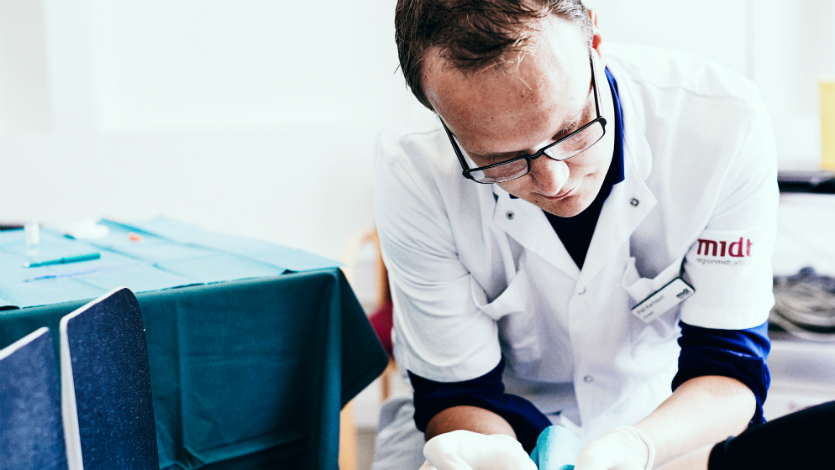
It was a happy day when Pall chose research over IT
Pall Karlsson
Pall Karlsson attended school in the north of Iceland, scoring rather mediocre marks. So, his dream of becoming a doctor or researcher – and helping people with amyotrophic lateral sclerosis, like his aunt – looked unattainable. This was his impression, at any rate, until the day he decided to swap IT studies for natural sciences.
“To my surprise, and thanks to terrific and engaged teachers, I started to blossom during biology, chemistry and mathematics classes and my grades quickly went up. I finally knew what I wanted to do and I went for it”, he says.
Pall, now 35, is living proof that dreams are not unattainable. With a Master’s in molecular biology and a PhD in medicine, he has worked at the Danish Pain Research Centre for eight years, is married and has two daughters.
His road to work in the field of diabetes went through neurology and neurological complications, and during his PhD fellowship at the Danish Pain Research Centre he helped implementing the skin biopsy technique, an important tool for confirming the diagnosis of peripheral neuropathy.
“However, while this technique is a terrific diagnostic tool, it doesn’t tell us anything about why the patients have their symptoms nor does it explain why some patients develop chronic pain while others don’t. This is the core of my postdoctoral research at the Danish Diabetes Academy. I want to know why some but not all diabetic patients develop neuropathic pain. Is there a difference between type 1 and type 2 patients with diabetic polyneuropathy? How frequent are neuropathic symptoms in the orofacial region?”
Today the majority of patients with painful symptoms are inadequately treated
Another important aspect of his diabetes research focuses on burning pain, one of the most common and devastating complaints of patients with diabetic polyneuropathy. Why do some patients develop this symptom?
“If we can expand the utilization of the skin biopsies and shed some light on the mechanisms behind diabetic polyneuropathy and the reason why some patients develop neuropathic pain that may ultimately have huge implication for our patients”, he says, and explains that the ultimate goal of their research is twofold. “We wish to find out why some patients develop pain so we hopefully can intervene sooner and before the patients develop their symptoms because once the damage has been done it is difficult to reverse it and secondly, we’re hoping that we can locate novel possible therapy targets so more diabetic patients can get sufficient treatment for their neuropathic symptoms”, says Pall Karlsson.
It is important to achieve more knowledge: Today the majority of patients with painful symptoms are inadequately treated and while much is known, many questions remain unanswered in terms of mechanisms and physiopathology.
Has not looked back
He concludes that it took a while for him to take the step and follow his dream. “After I did that I haven’t looked back”, he says. He conducts his research in collaboration with world-known institutions such as the University of Oxford, England, The Johns Hopkins Hospital, Yale University, Michigan University and Washington University, United States, and is regularly abroad on research visits.
Not only has Pall achieved all these things, he has also worked on amyotrophic lateral sclerosis, the illness his aunt suffers from. His MSc, on ‘Vesicle traffic defects in the wobbler mouse and human ALS patients skin fibroblasts’, earned him 12/12. Something his past teachers might well be surprised at!